Fistula Solution Receives FDA Breakthrough Device Designation for Innovative Limpet Device, Advancing Enterocutaneous Fistula Care

  • Breakthrough Device Designations are given by the U.S. FDA to expedite the review of technologies that can improve the lives of people with life-threatening or debilitating conditions.
  • Each year, tens of thousands of Americans suffer from enterocutaneous fistulas (ECF).
  • With Breakthrough Device Designation the Limpet™ Device could become available as a new treatment option sooner for these patients.

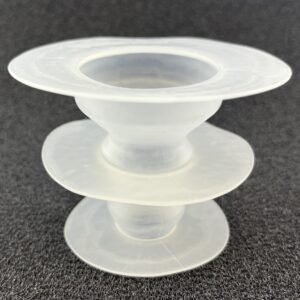
Fistula Solution, a leading medical device company in complex wound care, announced today that the U.S. Food and Drug Administration (FDA) has granted Breakthrough Device Designation to the Limpet™ device for severe abdominal openings unlikely to spontaneously close. This device is designed to reduce current complications associated with enterocutaneous fistulas, which has the potential to reduce healthcare costs and improve patient confidence and quality of life.

Enterocutaneous and other enteric, or intestinal, fistulas are challenging to manage, and the current standard of care is costly. In terms of charges billed to patients, the median total charges per hospital stay are $50,451, with a range of $24,439 to $109,4343.  The annual costs of enteric fistulas on the healthcare system are estimated to be close to $500,000,000. Additionally, the charges incurred by enteric fistula patients amount to approximately $1.5 billion.  These figures indicate the significant financial burden that enteric fistula patients impose on the healthcare system, highlighting the importance of effective management and prevention strategies for this condition.

The Limpet combines key aspects of fistula management — effluent containment and negative pressure wound therapy for effluent management and promotion of healing of intact and injured skin. The protection of the negative pressure dressing also simplifies nursing care, eliminates the need for frequent dressing changes, and protects the surrounding skin or wound, which all promote the patient’s global health.

“The Breakthrough Device Designation is a significant milestone for our company and validates our belief that the Limpet™ device has advantages over the current standard of care,” said Andy Obst, President of Fistula Solution. “Early clinical results are promising and suggest our device reduces the complications typically associated with fistulas and ostomies and better supports a patient’s ability to get back to life. We look forward to working with the FDA to make the technology accessible as quickly as possible.”

Early clinical data comparing the Limpet with the current standard of care demonstrated that the Limpet achieves a 99.4% average reduction in skin damage area or near total control of intestinal effluent for patients with enteric fistula complications. The Limpet was worn for an average of 3 days versus the 0.26 days for conventional dressings and showed zero leak failures in 14 device placements over 65 days of therapy, reducing patient or caregiver maintenance.  Additionally, patients with new skin grafts around their fistula experienced 95% graft take, which is remarkable because grafting around stomas is generally not feasible with conventional dressings.

The FDA Breakthrough Device program is designed to help accelerate the development and approval of medical devices and products that have the potential to provide more effective treatment or diagnosis of life-threatening or irreversibly debilitating diseases or conditions.  Receiving the Breakthrough Device Designation also facilitates the Medicare coverage for the device, which will help the Limpet device become more widely accessible for patients who require an ostomy procedure or develop enteric fistulas, benefitting both the healthcare system and the patient.


About Fistula Solution

Fistula Solution has a portfolio of devices designed to treat enteric fistulas and high output ostomy stomas. The company is committed to developing innovative new devices for post-surgical ostomy complications, rectovaginal fistulas, surgical drain wounds, and necrotizing soft tissue infections.

For further information visit www.fistulasolution.com.


  1. Moisture-Associated Skin Damage (MASD) | WoundSource
  2. Taneja, Charu, et al. "Clinical and economic burden of peristomal skin complications in patients with recent ostomies." Journal of Wound, Ostomy, and Continence Nursing 44.4 (2017): 350.
  3. Brooks NE, Idrees JJ, Steinhagen E, Giglia M, Stein SL. The impact of enteric fistulas on US hospital systems. Am J Surg. 2021;221(1):26-29. doi:10.1016/j.amjsurg.2020.06.017

Fistula Fun at Chicago WOCN Conference

The upcoming Professional Education Day of the Northern Illinois Affiliate of the Wound Ostomy and Continence Nurses Society (NIAWOCN) includes a pair of exciting enteric fistula presentations.  Dr. Erik Borncamp, Medical Director for The Wound Center at Silver Cross Hospital, will present "Ostomy, Fistula and Open Abdomen".  He will discuss the pathophysiology of fistulas and the challenges in closing them.

Mary Anne Obst, Complex Abdomen Specialist for Regions Hospital, will close the conference with her "Fun with Fistulas" presentation.  She will cover assessment and classification of the enteric fistula patient, medical management and wound care principles.

The NIAWOCN's 23rd annual professional education day is October 13, 2021 from 7:00am-4:00pm CST at Bobak's Signature Events and Conference Center in Woodridge, Illinois.

Enteric Fistula Care: Looking Beneath the Surface to Be Successful at SAWC Spring

The Complex Abdominal Reconstruction (CARS) team at Regions Hospital will present Enteric Fistula Care: Looking Beneath the Surface to Be Successful  at SAWC Spring on May 14th.

The team will provide the anatomical, surgical, and effluent management knowledge required to care for enteric fistula and complex ostomy patients. Understanding the anatomy and structures around a fistula or ostomy through imaging and other techniques is necessary for the fistula team to develop long-term medical and surgical repair plans. With this deeper understanding the wound care provider can develop appropriate effluent containment and wound healing strategies for the patient. This session will cover basic to advanced care of enteric fistulas, discuss why interpretation of imaging studies is important to the wound provider, and review anatomy of a fistula and surgical techniques that may be used.

High Output Session at Northeast Region WOCN Conference

Carol Rees Parrish MS, RDN will present High Output Ileostomy: Preventing Acute Kidney Injury at 3:00 PM EST on November 7th, 2020 during the Northeast Region of the WOCN's Virtual Conference.

Carol's presentation will help attendees:

  • Identify the clinical, psychological, and financial burdens patients with high output ileostomies face
  • Learn to systematically select and dose medications to decrease stool volume
  • Learn how to develop a plan to monitor new ileostomy patients after discharge

Carol's extensive knowledge around short bowel syndrome (SBS) will be beneficial to providers managing patients with high output fistulas or ileostomies.

Click here for conference and registration details.

Fistula Care Series at Northeast Region WOCN Conference

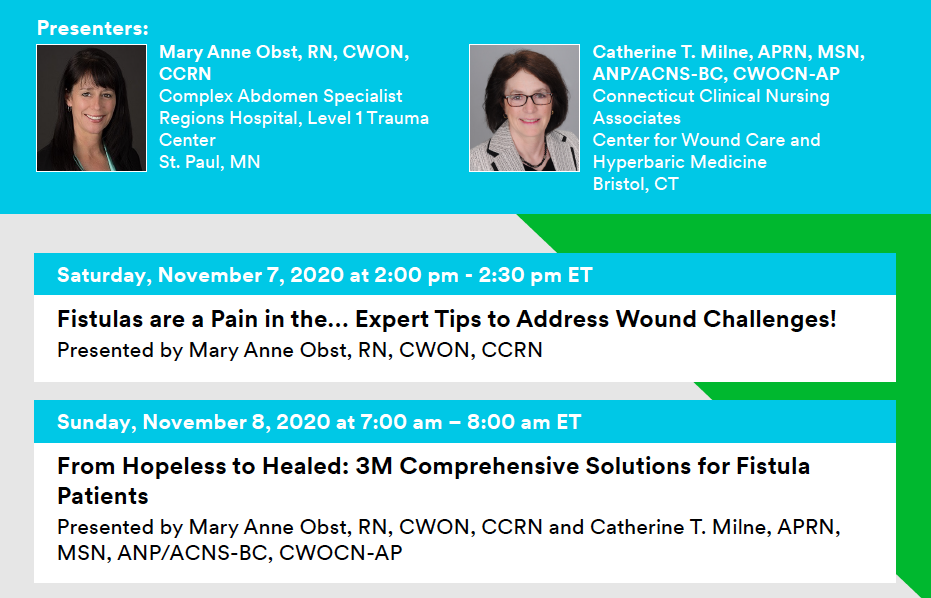
A 2-part series on fistula care will be presented November 7th and 8th during the 2020 Northeast Region of the WOCN's Virtual Conference.

The session Fistulas are a Pain in the… Expert Tips to Address Wound Challenges!Fistulas Are a Pain in the… Expert Tips to Address Wound Challenges! will be live-streamed on Saturday, November 7, 2020 at 2:00 PM EST.  Anyone - even those who are not registered for the conference - can attend using this link.

Then, on Sunday, November 8, 2020 the session From Hopeless to Healed: 3M Comprehensive Solutions for Fistula Patients will be presented live at 7:00 AM EST.  Similarly, anyone can use this link to attend, even if they have not registered for the conference.

Learning objectives for the series are to:

  • Discuss S.N.A.P (Skin/Sepsis, Nutrition, Anatomy, Procedure), the acronym to design a fistula management care pathway - Acute, Post-Acute and beyond!
  • Illustrate via cases, techniques tips and pearls on how to manage containment systems to prevent skin damage related to fistula effluent
  • Demonstrate negative pressure wound therapy to optimize wound management
  • Examine the role of planning, communication and technology to ease care transitions
  • Investigate and discuss gaps in current practice for managing skin preparation and injury related to fistula effluent spillage
  • Discuss challenges in skin care after increased mobility in post-acute settings

Click here for conference and registration details.

Management of Enteric Fistulae at AASPA

Attend Management of Enteric Fistulae during the American Association of Surgical Physician Assistants (AASPA) virtual conference October 17th at 8:05 AM Central Time.

Kristen Lindvall, PA-C from Regions Hospital will provide practical applications and insight on enteric fistula management. Engage and ask questions from the comfort of your home.

University of Washington Virtual Wound Care Conference

The University of Washington's Virtual Wound Care Update Conference begins November 13, 2020.

This conference addresses current scientific, clinical and professional practice issues across care settings related to acute and chronic wounds including evidence-based and multidisciplinary strategies for assessing and intervening to achieve successful outcomes. Presentations will update the professional with recent changes to practice and assumes a basic understanding of wound management principles. Teaching methods include lecture, discussion boards, and case studies.

The session Fistulas and Negative Pressure Wound Therapy will be delivered on demand via Canvas to best fit attendees individual schedules.  The program schedule also includes a networking lunch via Zoom on November 13th.

Isolation of Enteric Fistulas for Skin Graft Placement

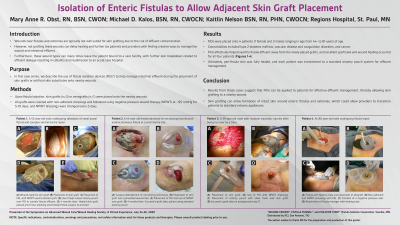
The Wound, Ostomy and Continence Nursing Certification Board (WOCNCB) has shared the case study poster Isolation of Enteric Fistulas to Allow Adjacent Skin Graft Placement.

Download the poster to see how Fistula Solution devices help manage intestinal effluent during the placement of skin grafts or artificial skin substitutes onto nearby wounds.

Complex Wounds and Fistula: How to Wow ‘Em!

Attend Complex Wounds and Fistula: How to Wow ‘Em! during the Wild on Wounds virtual conference September 27th at 2:40 PM PDT.

This session will demonstrate best practices in fistula drainage containment, negative pressure wound therapy, skin management to reduce discomfort, and pouching to heal the wound and keep the patient clean, dry, and comfortable during the waiting period before abdominal wall reconstruction.

Techniques and tips for massive soft tissue injuries such as necrotizing fasciitis and Fournier's gangrene utilizing the newest negative pressure therapy will also be covered.

Managing the Compromised Skin and Fistulas of Bariatric Patients at WoundCon

Attend Managing the Compromised Skin and Fistulas of Bariatric Patients during WoundCon on July 17th at 4:30 PM EDT.

Bariatric patients face daily challenges with personal care, skin breakdown, and the need for appropriate equipment. These patients need physical and emotional preparation for the ostomy, stoma placement, and postoperative self-care. If wounds develop, negative pressure wound therapy has been found effective in these patients.