
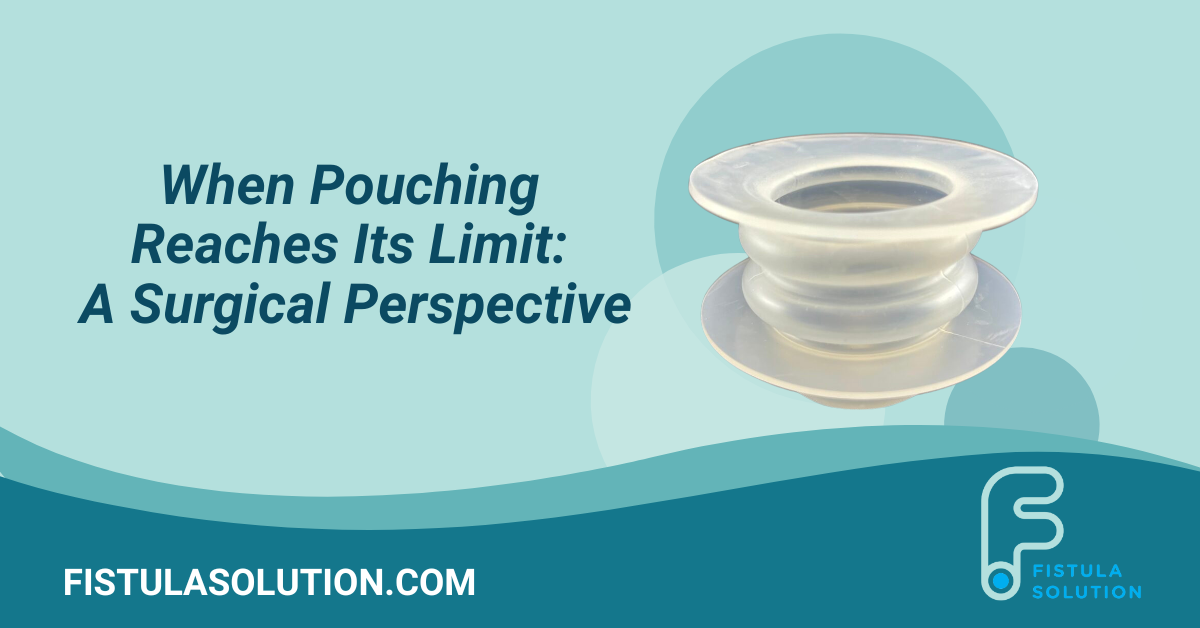
When Pouching Reaches Its Limit: A Surgical Perspective

Pouching remains the standard for ostomy and fistula management. However, in complex abdominal cases—particularly with open wounds, retracted stoma, or high-output fistulas—pouching alone may not provide reliable protection.

In these scenarios, isolation devices serve as a critical adjunct, enabling effluent to be controlled and consistently directed into a pouch.


Why Pouching Fails

Pouching challenges are typically driven by:

  • Open peristomal wounds
  • Retraction or difficult fistula/stoma site
  • High-volume effluent

These factors can compromise adhesion, leading to leakage and frequent appliance failure.


Recognizing When there is a Need

A change in strategy should be considered when:

  • Leakage interferes with wound healing or patient mobility and quality of life
  • Dressing and pouch changes become frequent and/or resource-intensive
  • Peristomal or periwound breakdown persists

These challenges are often due to a dressing limitation, not a technique issue.


Isolation as an Adjunct to Assist in Pouching

Isolation devices are not an alternative to pouching—they are a tool to make pouching viable in hostile environments.

They function to:

  • Physically separate effluent from vulnerable tissue
  • Create a controlled channel directing output into the pouch
  • Protect surrounding tissue to support healing

Where Fistula Solution Fits

Fistula Solution devices, including the Wound Crown®, are designed to assist in successful pouching.

They provide a structured method to isolate effluent and direct it into a pouch, helping restore control in difficult-to-manage cases and supporting surgical and wound care objectives.


For More Information

Want to learn more? For information on device availability within your hospital system or to discuss clinical coordination, contact Fistula Solution at info@fistulasolution.com.

You May Already Have Access to Fistula Solution Devices

At a recent surgical conference, a recurring comment was:

“I didn’t realize your devices were already available in our hospital system.”

Devices such as the Wound Crown® are approved for use and available in most U.S. hospital systems.


How to Access Fistula Solution Devices

If you are unsure whether Fistula Solution devices are available within your system, consider reaching out to:

  • Your Wound, Ostomy, and Continence (WOC) nurse team
  • Your purchasing manager
  • The value analysis or procurement department

These groups can confirm whether the devices are already contracted, approved, or stocked within your facility.

If an internal inquiry does not provide clarity, you may also contact Fistula Solution directly at info@fistulasolution.com for assistance.


If Fistula Solution Devices Are Not Yet Available

Hospitals follow structured review pathways for new product requests.

If Fistula Solution devices are not currently approved within your system, value analysis materials and supporting clinical information can be provided to assist with your internal review process.

Complex fistula management often requires specialized tools. In many cases, those tools may already be accessible within your system — they simply may not be widely recognized.

If you are uncertain about availability, contact your internal supply team or reach out to Fistula Solution info@fistulasolution.com and we can verify availability.

Help Fistula Patients Reduce Their Surgery Risk with the CeDAR App

Download the free CeDAR app to facilitate conversations with patients about their fistula repair surgery risk profile.  The app is available in the App Store or Google Play.

Users simply answer eight questions about themselves, including height and weight. A percentage chance of developing specific postoperative complications requiring treatment is calculated, along with the corresponding cost of this treatment. These results can then be used to discuss a patient’s risk for wound problems after surgery and what changes they can make to improve the odds for a good result.

Wound problems after surgery are the major reason for increased cost of surgery, including the added cost of other procedures, hospital stays and clinic visits. Because of their wounds, these patients often are not able to work and lose time and money because of specialty wound care, travel, clinic visits and/or hospital stays. The app predicts the risks and financial impact of wound-related problems using a mathematical equation derived from real patient data. Helping patients understand their risks can facilitate a deeper conversation about behavioral changes that will reduce the risk of wound problems.

Fistula Training with the thumbroll App

The free thumbroll app has a new step-by-step training module on Enteroatmospheric Fistula Wound Management.  Simply download it from the App Store or Google Play and start learning.

The fistula module is in the General Surgery section of the app.  thumbroll uses real images to show how to use the Wound Crown in detailed steps, making it easily digestible.  Learn at your pace as you scroll through each step of the process.

thumbroll is like a visual checklist. Content is broken down to the component steps, allowing you to just see what is necessary to learn the material.

thumbroll is a free learning tool for all medical trainees and professionals worldwide and it is available for iOS & Android.

For more information:

  • facebook.com/thumbrollmed
  • instagram.com/thumbroll
  • youtube.com/c/thumbrollmedical